Editorial issue 31.3 Article Swipe
 YOU?
·
· 2020
· Open Access
·
· DOI: https://doi.org/10.1002/cav.1930
· OA: W3035666612
YOU?
·
· 2020
· Open Access
·
· DOI: https://doi.org/10.1002/cav.1930
· OA: W3035666612
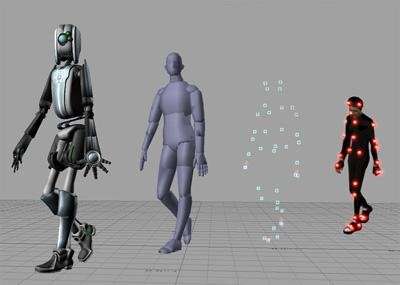
This issue contains three papers. In the first paper, Manoj Kumar Muni and Dayal R. Parhi, from the National Institute of Technology in Rourkela, India, and Priyadarshi Biplab Kumar, from the National Institute of Technology in Hamirpur, India, consider the use of gray wolf optimization controller (GWOC) as a multiobjective technique for multiple humanoid navigation. Upon activation of GWOC, the humanoids mimic the group hunting behavior of gray wolves and navigate toward the target in a collision-free manner in the presence of both static and dynamic hurdles. The wolves in the pack will either diverge for searching prey or converge together for attacking the prey following the best search agent. GWOC is able to keep the humanoid free from being trapped in local minima, whereas it facilitates it to head toward global minima. GWOC provides better results than other intelligent techniques because of its five characteristics: safe boundary, protection, following, hunting, and caring. In the second paper, Lianyao Wu, Wanggen Wan, Xiaoqing Yu, Chunkai Ye, and A.A.M. Muzahid, from Shanghai University, China, present a real-time augmented reality framework based on a semidense method with CPU. Specifically, the semidense method searches pixels with high gradients in each keyframe and estimates accurate depths by fusing matching pixels in other keyframes. The authors propose an outlier removal method that excludes 3D points outside the camera trajectory. By integrating this method, their framework preserves clean edges of the real environment. The experimental results on the data set show that their proposed framework has better surface reconstruction accuracy than other methods and their tracking thread runs in an acceptable speed when the semidense mapping thread runs backend. With the benefit of the robust camera and the aligned surface, virtual characters of their AR application enable realistic movement and collision. In the last paper, Jongmin Kim, from Kangwon National University in Chuncheon, Korea, Yeongho Seol, from Weta Digital Ltd in Wellington, New Zealand, and Hoemin Kim and Taesoo Kwon, from Hanyang University, Korea, present a novel interactive inverse kinematics (IK) framework that automatically and efficiently handles various types of collisions and spatial relationship. For the collision handling, they suggest a new type of linear constraint (half-space constraint) and a novel collision-response strategy based on gradual constraint accumulation. Specifically, the constraints that were used in the previous iterations continue to be used while more constraints are added to finally resolve the collisions. This approach also allows the user to edit human motion without any repetitive procedures and tuning the parameters. Regarding the spatial relationship, the authors provide another linear constraint that preserves complex spatial relationships between body parts. Their approach is novel in that both half-space constraints for collision handling and relative constraints for pose editing are embedded into an IK solver.