Molecular Detection of Tick-Borne Pathogens in Humans with Tick Bites and Erythema Migrans, in the Netherlands Article Swipe
Related Concepts
Anaplasma phagocytophilum
Borrelia burgdorferi
Tick
Tick-borne disease
Erythema migrans
Borrelia
Ixodes scapularis
Biology
Anaplasma
relapsing fever
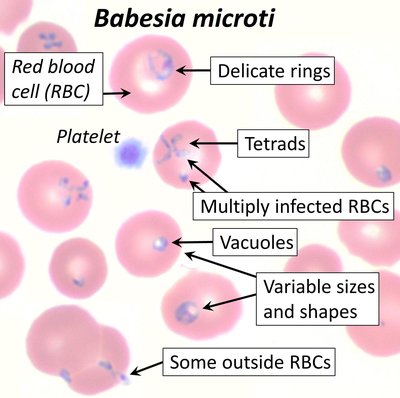
Babesia
Ixodes
Virology
Spotted fever
Lyme disease
Immunology
Rickettsia
Ixodidae
Virus
Antibody
Lyme borreliosis
Setareh Jahfari
,
Agnetha Hofhuis
,
Manoj Fonville
,
Joke van der Giessen
,
Wilfrid van Pelt
,
Hein Sprong
·
 YOU?
·
· 2016
· Open Access
·
· DOI: https://doi.org/10.1371/journal.pntd.0005042
· OA: W2528711546
YOU?
·
· 2016
· Open Access
·
· DOI: https://doi.org/10.1371/journal.pntd.0005042
· OA: W2528711546
YOU?
·
· 2016
· Open Access
·
· DOI: https://doi.org/10.1371/journal.pntd.0005042
· OA: W2528711546
Based on molecular detection techniques, the probability of infection with a tick-borne pathogen other than Lyme spirochetes after a tick bite is roughly 2.4%, in the Netherlands. Similarly, among patients with erythema migrans, the probability of a co-infection with another tick-borne pathogen is approximately 2.7%. How often these infections cause disease symptoms or to what extend co-infections affect the course of Lyme borreliosis needs further investigations.
Related Topics






























Finding more related topics…