Modern description of Rayleigh's criterion Article Swipe
 YOU?
·
· 2019
· Open Access
·
· DOI: https://doi.org/10.1103/physreva.99.013808
· OA: W2784018686
YOU?
·
· 2019
· Open Access
·
· DOI: https://doi.org/10.1103/physreva.99.013808
· OA: W2784018686
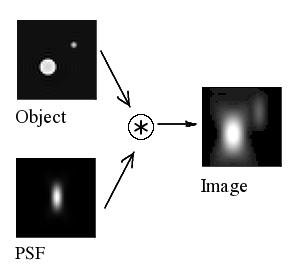
Rayleigh's criterion states that it becomes essentially difficult to resolve\ntwo incoherent optical point sources separated by a distance below the width of\npoint spread functions (PSF), namely in the subdiffraction limit. Recently,\nresearchers have achieved superresolution for two incoherent point sources with\nequal strengths using a new type of measurement technique, surpassing\nRayleigh's criterion. However, situations where more than two point sources\nneeded to be resolved have not been fully investigated. Here we prove that for\nany incoherent sources with arbitrary strengths, a one- or two-dimensional\nimage can be precisely resolved up to its second moment in the subdiffraction\nlimit, i.e. the Fisher information (FI) is non-zero. But the FI with respect to\nhigher order moments always tends to zero polynomially as the size of the image\ndecreases, for any type of non-adaptive measurement. We call this phenomenon a\nmodern description of Rayleigh's criterion. For PSFs under certain constraints,\nthe optimal measurement basis estimating all moments in the subdiffraction\nlimit for 1D weak-source imaging is constructed. Such basis also generates the\noptimal-scaling FI with respect to the size of the image for 2D or\nstrong-source imaging, which achieves an overall quadratic improvement compared\nto direct imaging.\n