Contested Paradigm in Raising Zebrafish (Danio rerio) Article Swipe
 YOU?
·
· 2018
· Open Access
·
· DOI: https://doi.org/10.1089/zeb.2017.1515
· OA: W2792684096
YOU?
·
· 2018
· Open Access
·
· DOI: https://doi.org/10.1089/zeb.2017.1515
· OA: W2792684096
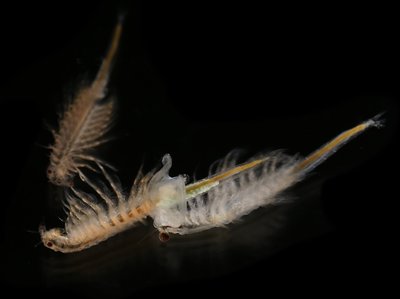
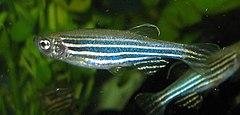
The current body of work on rearing larval/juvenile zebrafish is based on (1) utilization of freshwater and (2) diurnal light/dark cycle, (3) provision of live feed at modest density, and (4) culture in high visibility environment. We challenged these rearing approaches by maintaining zebrafish under constant light for 46-48 days (days postfertilization [dpf]), while securing continuous feeding in high turbidity and saline (1.8-2.1 parts per thousand) environment for the experiment's duration, allowing 24 h feeding/growth of fish from first exogenous feeding to maturation. There was no evidence of negative effects on zebrafish larvae behavior, growth, survival, and life cycle duration at constant illumination when food was continuously available. Zebrafish were stocked at high initial density (100 larvae/L) in a static system and fed high densities of rotifers (Brachionus plicatilis) (200-400/mL) from 6 to 12 dpf. Fish density was then reduced by 50% and two diet treatments, live rotifers or brine shrimp (Artemia) nauplii (10/mL), followed. Fish were reared on these two diets until first maturation. Performance of adult zebrafish fed live rotifer followed by Artemia nauplii diet was the highest recorded in the literature after 42 dpf, 250 ± 29 (males) and 430 ± 5 mg (females). Use of these rearing conditions, during the entire life cycle, until reproduction, resulted in the shortest ever recorded generation time (from egg to egg) of 43-45 dpf and fertilization rate (1 dpf) of 80.3%-94%.