Frank-Starling mechanism and short-term adjustment of cardiac flow Article Swipe
 YOU?
·
· 2017
· Open Access
·
· DOI: https://doi.org/10.1242/jeb.167106
· OA: W2950710101
YOU?
·
· 2017
· Open Access
·
· DOI: https://doi.org/10.1242/jeb.167106
· OA: W2950710101
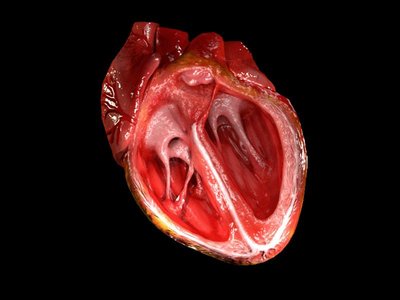
The Frank-Starling Law of the heart is a filling-force mechanism (FFm), a positive relationship between the distension of a ventricular chamber and its force of ejection, and such a mechanism is found across all the studied vertebrate lineages. The functioning of the cardiovascular system is usually described by means of the cardiac and vascular functions, the former related to the contractility of the heart and the latter related to the after-load imposed to the ventricle. The crossing of these functions is the so-called operation point, and the FFm is supposed to play a stabilizing role for the short-term variations in the working of the system. In the present study, we analyze whether the FFm is truly responsible for such a stability within two different settings: one-ventricle and two-ventricle hearts. To approach the query, we linearized the region around an arbitrary operation point and put forward a dynamical system of differential equations to describe the relationship among volumes in face of blood flows governed by pressure differences between compartments. Our results show that the FFm is not necessary to give stability to an operation point. Thus, what forces might have selected and maintained such a mechanism in all vertebrates? The present results indicate three different and complementary roles for the filling-force mechanism: (1) it decreases the demands of a central controlling system over the circulatory system; (2) it smooths out perturbations in volumes; and (3) it guarantees faster transitions between operation points, i.e., it allows for rapid changes in cardiac output.