Earth’s radiative imbalance from the Last Glacial Maximum to the present Article Swipe
Related Concepts
Deglaciation
Ice sheet
Ice-albedo feedback
Earth's energy budget
Climatology
Radiative transfer
Cryosphere
Energy budget
Environmental science
Atmospheric sciences
Atmosphere (unit)
Radiative cooling
Earth system science
Last Glacial Maximum
Glacial period
Geology
Sea ice
Oceanography
Ice stream
Geography
Meteorology
Physics
Radiation
Thermodynamics
Quantum mechanics
Geomorphology
Daniel Baggenstos
,
Marcel Häberli
,
J. H. M. M. Schmitt
,
Sarah Shackleton
,
Benjamin Birner
,
Jeffrey P. Severinghaus
,
Thomas Kellerhals
,
Hubertus Fischer
·
 YOU?
·
· 2019
· Open Access
·
· DOI: https://doi.org/10.1073/pnas.1905447116
· OA: W2961161646
YOU?
·
· 2019
· Open Access
·
· DOI: https://doi.org/10.1073/pnas.1905447116
· OA: W2961161646
YOU?
·
· 2019
· Open Access
·
· DOI: https://doi.org/10.1073/pnas.1905447116
· OA: W2961161646
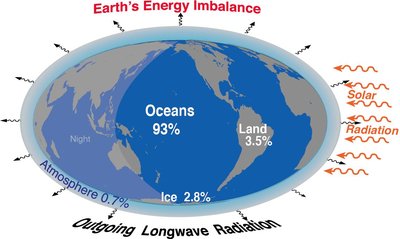
Significance Earth’s radiative imbalance determines whether energy is flowing into or out of the ocean–atmosphere system. The present, anthropogenic, positive imbalance drives global warming. This study reconstructs the radiative imbalance for the last deglaciation, ∼20,000 to 10,000 y ago. During the deglaciation, a positive imbalance was maintained for several thousand years, which brought the climate system from the last ice age into the Holocene warm period. We show that the imbalance varied significantly during this time, possibly due to changes in ocean circulation that affect the radiative energy fluxes, highlighting the importance of internal variability in Earth’s energy budget.
Related Topics
































Finding more related topics…