Can an off-axis gamma-ray burst jet in GW170817 explain all the electromagnetic counterparts? Article Swipe
 YOU?
·
· 2018
· Open Access
·
· DOI: https://doi.org/10.1093/ptep/pty036
· OA: W2963762503
YOU?
·
· 2018
· Open Access
·
· DOI: https://doi.org/10.1093/ptep/pty036
· OA: W2963762503
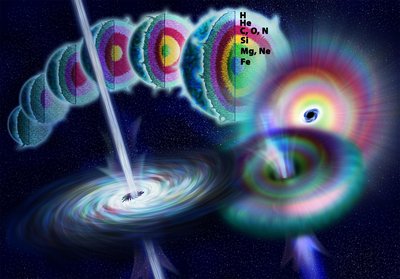
Gravitational waves from a merger of two neutron stars (NSs) were discovered for the first time in GW170817, together with diverse electromagnetic (EM) counterparts. To make constraints on a relativistic jet from the NS merger, we calculate the EM signals in (1) the short gamma-ray burst sGRB 170817A from an off-axis jet, (2) the optical–infrared macronova (or kilonova), especially the blue macronova, from a jet-powered cocoon, and (3) the X-ray and radio afterglows from the interaction between the jet and interstellar medium. We find that a typical sGRB jet is consistent with these observations, and there is a parameter space to explain all the observations in a unified fashion with an isotropic energy |$\sim 10^{51}$|–|$10^{52}$| erg, opening angle |$\sim 20^{\circ}$|, and viewing angle |$\sim 30^{\circ}$|. The off-axis emission is less de-beamed than the point-source case because the viewing angle is comparable to the opening angle. We also analytically show that the jet energy accelerates a fair fraction of the merger ejecta to a sub-relativistic velocity |$\sim 0.3$|–|$0.4 c$| as a cocoon in a wide parameter range. The ambient density might be low |$\sim 10^{-3}$|–|$10^{-6}$| cm|$^{-3}$|, which can be tested by future observations of radio flares and X-ray remnants.