Mapping Obscuration to Reionization with ALMA (MORA): 2 mm Efficiently Selects the Highest-redshift Obscured Galaxies Article Swipe
 YOU?
·
· 2021
· Open Access
·
· DOI: https://doi.org/10.3847/1538-4357/ac2eb4
· OA: W3205120522
YOU?
·
· 2021
· Open Access
·
· DOI: https://doi.org/10.3847/1538-4357/ac2eb4
· OA: W3205120522
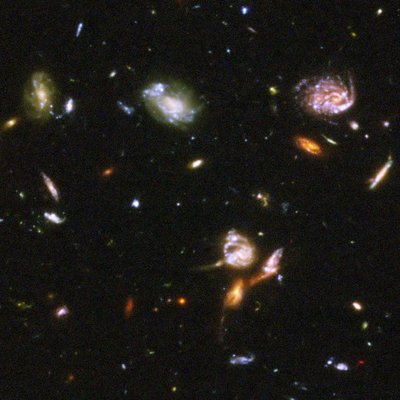
We present the characteristics of 2 mm selected sources from the largest Atacama Large Millimeter/submillimeter Array (ALMA) blank-field contiguous survey conducted to date, the Mapping Obscuration to Reionization with ALMA (MORA) survey covering 184 arcmin 2 at 2 mm. Twelve of 13 detections above 5 σ are attributed to emission from galaxies, 11 of which are dominated by cold dust emission. These sources have a median redshift of <mml:math xmlns:mml="http://www.w3.org/1998/Math/MathML" overflow="scroll"> <mml:mo stretchy="false">〈</mml:mo> <mml:msub> <mml:mrow> <mml:mi>z</mml:mi> </mml:mrow> <mml:mrow> <mml:mn>2</mml:mn> <mml:mspace width="0.25em"/> <mml:mi>mm</mml:mi> </mml:mrow> </mml:msub> <mml:mo stretchy="false">〉</mml:mo> <mml:mo>=</mml:mo> <mml:msubsup> <mml:mrow> <mml:mn>3.6</mml:mn> </mml:mrow> <mml:mrow> <mml:mo>−</mml:mo> <mml:mn>0.3</mml:mn> </mml:mrow> <mml:mrow> <mml:mo>+</mml:mo> <mml:mn>0.4</mml:mn> </mml:mrow> </mml:msubsup> </mml:math> primarily based on optical/near-infrared photometric redshifts with some spectroscopic redshifts, with 77% ± 11% of sources at z > 3 and 38% ± 12% of sources at z > 4. This implies that 2 mm selection is an efficient method for identifying the highest-redshift dusty star-forming galaxies (DSFGs). Lower-redshift DSFGs ( z < 3) are far more numerous than those at z > 3 yet are likely to drop out at 2 mm. MORA shows that DSFGs with star formation rates in excess of 300 M ⊙ yr −1 and a relative rarity of ∼10 −5 Mpc −3 contribute ∼30% to the integrated star formation rate density at 3 < z < 6. The volume density of 2 mm selected DSFGs is consistent with predictions from some cosmological simulations and is similar to the volume density of their hypothesized descendants: massive, quiescent galaxies at z > 2. Analysis of MORA sources’ spectral energy distributions hint at steeper empirically measured dust emissivity indices than reported in typical literature studies, with <mml:math xmlns:mml="http://www.w3.org/1998/Math/MathML" overflow="scroll"> <mml:mo stretchy="false">〈</mml:mo> <mml:mi>β</mml:mi> <mml:mo stretchy="false">〉</mml:mo> <mml:mo>=</mml:mo> <mml:msubsup> <mml:mrow> <mml:mn>2.2</mml:mn> </mml:mrow> <mml:mrow> <mml:mo>−</mml:mo> <mml:mn>0.4</mml:mn> </mml:mrow> <mml:mrow> <mml:mo>+</mml:mo> <mml:mn>0.5</mml:mn> </mml:mrow> </mml:msubsup> </mml:math> . The MORA survey represents an important step in taking census of obscured star formation in the universe’s first few billion years, but larger area 2 mm surveys are needed to more fully characterize this rare population and push to the detection of the universe’s first dusty galaxies.