Polymer glass transition as a local rigidity transition Article Swipe
 YOU?
·
· 2015
· Open Access
·
· OA: W2758559056
YOU?
·
· 2015
· Open Access
·
· OA: W2758559056
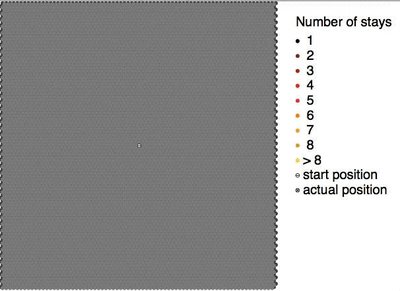
We re-examine the physical origin of the polymer glass transition from the point of view of marginal rigidity, which is achieved above a certain number of intermolecular contacts. In the case of polymer chains in a melt / poor solvent, each monomer has two neighbors bound by covalent bonds and also a number of central-force contacts modelled by the Lennard-Jones (LJ) potential. We find that when the average number of contacts per monomer (covalent and non-covalent) exceeds the critical value z*=4, the system becomes solid and the dynamics arrested - a state that we declare the glass. Coarse-grained Brownian dynamics simulations show that at sufficient strength of LJ attraction (which effectively represents the depth of quenching, or the quality of solvent) the polymer globule indeed crosses the threshold of z*=4, and does become a glass. We verify this by showing the distinction between the `liquid' polymer droplet at z z*, which retains its shape frozen at the moment of z* crossover. These results provide a robust working criterion to tell the liquid apart from the glass for the linear polymers.