Room-Temperature Decomposition of the Ethaline Deep Eutectic Solvent Article Swipe
 YOU?
·
· 2025
· Open Access
·
· DOI: https://doi.org/10.1021/acs.jpclett.4c03645
· OA: W4408515760
YOU?
·
· 2025
· Open Access
·
· DOI: https://doi.org/10.1021/acs.jpclett.4c03645
· OA: W4408515760
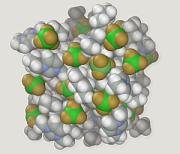
Environmentally benign, nontoxic electrolytes with combinatorial design spaces are excellent candidates for green solvents, green leaching agents, and carbon capture sources. We examine ethaline, a 2:1 molar ratio of ethylene glycol and choline chloride. Despite its touted green credentials, we find partial decomposition of ethaline into toxic chloromethane and dimethylaminoethanol at room temperature, limiting its sustainable advantage. We experimentally characterize these decomposition products and computationally develop a general, quantum-chemically accurate workflow to understand its decomposition. We find that fluctuations in the hydrogen bonds bind chloride near reaction sites, initiating the reaction between choline cations and chloride anions. The strong hydrogen bonds formed in ethaline are resistant to thermal perturbations, entrapping Cl in high-energy states and promoting the uphill reaction. In the design of stable green solvents, we recommend detailed evaluation of the hydrogen-bonding potential energy landscape as a key consideration for generating stable solvent mixtures.