
Adversarially Trained Convolutional Neural Networks for Semantic\n Segmentation of Ischaemic Stroke Lesion using Multisequence Magnetic\n Resonance Imaging Article Swipe
 YOU?
·
· 2019
· Open Access
·
· DOI: https://doi.org/10.48550/arxiv.1908.01176
YOU?
·
· 2019
· Open Access
·
· DOI: https://doi.org/10.48550/arxiv.1908.01176
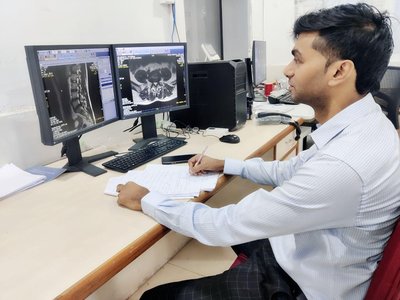
Ischaemic stroke is a medical condition caused by occlusion of blood supply\nto the brain tissue thus forming a lesion. A lesion is zoned into a core\nassociated with irreversible necrosis typically located at the center of the\nlesion, while reversible hypoxic changes in the outer regions of the lesion are\ntermed as the penumbra. Early estimation of core and penumbra in ischaemic\nstroke is crucial for timely intervention with thrombolytic therapy to reverse\nthe damage and restore normalcy. Multisequence magnetic resonance imaging (MRI)\nis commonly employed for clinical diagnosis. However, a sequence singly has not\nbeen found to be sufficiently able to differentiate between core and penumbra,\nwhile a combination of sequences is required to determine the extent of the\ndamage. The challenge, however, is that with an increase in the number of\nsequences, it cognitively taxes the clinician to discover symptomatic\nbiomarkers in these images. In this paper, we present a data-driven fully\nautomated method for estimation of core and penumbra in ischaemic lesions using\ndiffusion-weighted imaging (DWI) and perfusion-weighted imaging (PWI) sequence\nmaps of MRI. The method employs recent developments in convolutional neural\nnetworks (CNN) for semantic segmentation in medical images. In the absence of\navailability of a large amount of labeled data, the CNN is trained using an\nadversarial approach employing cross-entropy as a segmentation loss along with\nlosses aggregated from three discriminators of which two employ relativistic\nvisual Turing test. This method is experimentally validated on the ISLES-2015\ndataset through three-fold cross-validation to obtain with an average Dice\nscore of 0.82 and 0.73 for segmentation of penumbra and core respectively.\n
Related Topics To Compare & Contrast




- Type
- preprint
- Language
- en
- Landing Page
- http://arxiv.org/abs/1908.01176
- https://arxiv.org/pdf/1908.01176
- OA Status
- green
- Cited By
- 1
- Related Works
- 10
- OpenAlex ID
- https://openalex.org/W4288267871