
Application of data-driven surrogate models for active human model response prediction and restraint system optimization Article Swipe
Julian Hay
,
Lars Schories
,
Eric Bayerschen
,
Peter Wimmer
,
Oliver Zehbe
,
Stefan Kirschbichler
,
Jörg Fehr
·
 YOU?
·
· 2023
· Open Access
·
· DOI: https://doi.org/10.3389/fams.2023.1156785
YOU?
·
· 2023
· Open Access
·
· DOI: https://doi.org/10.3389/fams.2023.1156785
YOU?
·
· 2023
· Open Access
·
· DOI: https://doi.org/10.3389/fams.2023.1156785
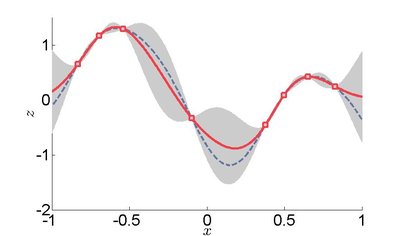
Surrogate models are a must-have in a scenario-based safety simulation framework to design optimally integrated safety systems for new mobility solutions. The objective of this study is the development of surrogate models for active human model responses under consideration of multiple sampling strategies. A Gaussian process regression is chosen for predicting injury values based on the collision scenario, the occupant's seating position after a pre-crash movement and selected restraint system parameters. The trained models are validated and assessed for each sampling method and the best-performing surrogate model is selected for restraint system parameter optimization.
Related Topics To Compare & Contrast



Concepts
Surrogate model
Kriging
Gaussian process
Computer science
Sampling (signal processing)
Regression analysis
Process (computing)
Machine learning
Artificial intelligence
Gaussian
Operating system
Computer vision
Physics
Quantum mechanics
Filter (signal processing)
Metadata
- Type
- article
- Language
- en
- Landing Page
- https://doi.org/10.3389/fams.2023.1156785
- https://www.frontiersin.org/articles/10.3389/fams.2023.1156785/pdf?isPublishedV2=False
- OA Status
- gold
- References
- 17
- Related Works
- 10
- OpenAlex ID
- https://openalex.org/W4367322960
All OpenAlex metadata
Raw OpenAlex JSON
No additional metadata available.