Crystallization‐Induced Network Growth for Enhancing Hydrogel Mechanical Properties Article Swipe
 YOU?
·
· 2025
· Open Access
·
· DOI: https://doi.org/10.1002/smll.202500976
· OA: W4408706515
YOU?
·
· 2025
· Open Access
·
· DOI: https://doi.org/10.1002/smll.202500976
· OA: W4408706515
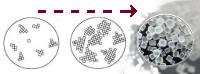
Inspired by the actin‐myosin‐mediated growth mechanisms in skeletal muscle, cyclic crystallization is employed to induce hydrogel self‐growth. Using polyacrylamide‐sodium acetate (PAM‐NaAc) hydrogel as a model system, the crystallization of NaAc triggers the stretching and subsequent fracture of polymer chains, generating mechanoradicals at strain‐concentrated regions. These reactive species facilitate the incorporation of polymerizable compounds (monomers and crosslinkers). Specifically, localized polymerization of poly(ethylene glycol) diacrylate (PEGDA) monomers occurs at fracture sites, leading to covalent network integration and achieving a 51.5‐fold Young's modulus enhancement (from 0.024 to 1.24 MPa over 50 crystallization cycles). This crystallization‐induced self‐growth mechanism enables programmable topology engineering in soft matter systems, with implications for adaptive biomedical implants and fatigue‐resistant soft robots.