
Predicting the stress-strain behavior of contractive and dilative materials using Gaussian process regression Article Swipe
 YOU?
·
· 2024
· Open Access
·
· DOI: https://doi.org/10.1063/5.0193446
YOU?
·
· 2024
· Open Access
·
· DOI: https://doi.org/10.1063/5.0193446
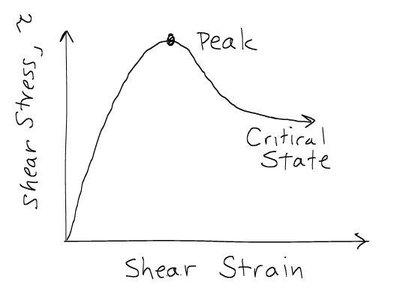
Sustainability urges the construction industry to search for alternative but suitable materials. To evaluate the applicability of these materials, engineers should conduct tests and predictive models. Shear stress – strain behavior of soils and geo-materials is important in the analysis of slope stability of embankment. Dilative and contractive phases are encountered in sandy and non-plastic types of material. While constitutive models are commonly used to predict the behavior of these materials, these models require laborious parameter determination and complex predictive equations. In this paper, the shear strength behavior of dilative and contractive materials, specifically mine tailings, were simulated using Gaussian process regression (GPR) machine learning. Three types of mine tailings tested under the direct shear apparatus were considered. The model predictors included five vertical stresses (KPa), three initial relative densities (%), and the shear strain (%) while the responses were the shear stress (KPa) and the volumetric strain (%). Results show that the GPR models provide good prediction of the shear stress – strain and volume change curves of the three mine tailings both for dilative and contractive samples with 98-99% accuracy on independent experiment data.
Related Topics To Compare & Contrast



- Type
- article
- Language
- en
- Landing Page
- https://doi.org/10.1063/5.0193446
- https://pubs.aip.org/aip/acp/article-pdf/doi/10.1063/5.0193446/19581199/030056_1_5.0193446.pdf
- OA Status
- bronze
- References
- 12
- Related Works
- 10
- OpenAlex ID
- https://openalex.org/W4391639192