

Description
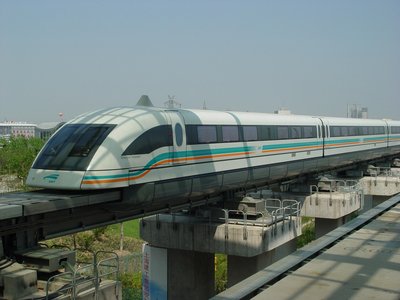
The Chuo Shinkansen (中央新幹線, Central Shinkansen ) is a Japanese maglev line under construction between Tokyo and Nagoya, with plans for extension to Osaka. Its initial section is between Shinagawa Station in Tokyo and Nagoya Station in Nagoya, with stations in Sagamihara, Kōfu, Iida and Nakatsugawa. Following the completion of the Tokyo-Nagoya line, the line will extend to connect stations in Mie, Nara and Osaka. The line is expected to connect Tokyo and Nagoya in 40 minutes, and eventually Tokyo and Osaka in 67 minutes, running at a maximum speed of 505 km/h (314 mph). About 90% of the 286-kilometer (178 mi) line to Nagoya will be tunnels.
The Chuo Shinkansen is the culmination of Japanese maglev development since the 1970s, a government-funded project initiated by Japan Airlines and the former Japanese National Railways (JNR). Central Japan Railway Company (JR Central) now operates the facilities and research. The line is intended to be built by extending and incorporating the existing Yamanashi test track (see below). The trainsets themselves are popularly known in Japan as linear motor car (リニアモーターカー, rinia mōtā kā ), though there have been many technical variations.
Government permission to proceed with construction was granted on 27 May 2011. Construction of the line, which is expected to cost over ¥9 trillion, commenced in 2014. The start date of commercial service is currently unknown, after Shizuoka Prefecture denied permission for construction work on a portion of the route in June 2020. JR Central originally aimed to begin commercial service between Tokyo and Nagoya in 2027, with the Nagoya–Osaka section planned to be completed as early as 2037. Originally, the Nagoya-Osaka section was planned to be completed as late as 2045, but the date was moved up following a loan from the Japanese government.