

Description
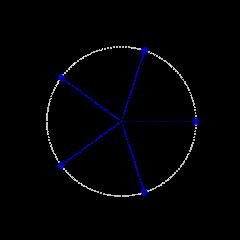
In mathematics, the n th cyclotomic polynomial, for any positive integer n , is the unique irreducible polynomial with integer coefficients that is a divisor of x n − 1 {\displaystyle x^{n}-1} and is not a divisor of x k − 1 {\displaystyle x^{k}-1} for any k < n. Its roots are all n th primitive roots of unity e 2 i π k n {\displaystyle e^{2i\pi {\frac {k}{n}}}} , where k runs over the positive integers not greater than n and coprime to n (and i is the imaginary unit). In other words, the n th cyclotomic polynomial is equal to
Φ n ( x ) = ∏ gcd ( k , n ) = 1 1 ≤ k ≤ n ( x − e 2 i π k n ) . {\displaystyle \Phi _{n}(x)=\prod _{\stackrel {1\leq k\leq n}{\gcd(k,n)=1}}\left(x-e^{2i\pi {\frac {k}{n}}}\right).}
It may also be defined as the monic polynomial with integer coefficients that is the minimal polynomial over the field of the rational numbers of any primitive n th-root of unity ( e 2 i π / n {\displaystyle e^{2i\pi /n}} is an example of such a root).
An important relation linking cyclotomic polynomials and primitive roots of unity is
∏ d ∣ n Φ d ( x ) = x n − 1 , {\displaystyle \prod _{d\mid n}\Phi _{d}(x)=x^{n}-1,}
showing that x is a root of x n − 1 {\displaystyle x^{n}-1} if and only if it is a d th primitive root of unity for some d that divides n.
Cyclotomic Polynomial News
Collections
No collections available for this topic.