

Description
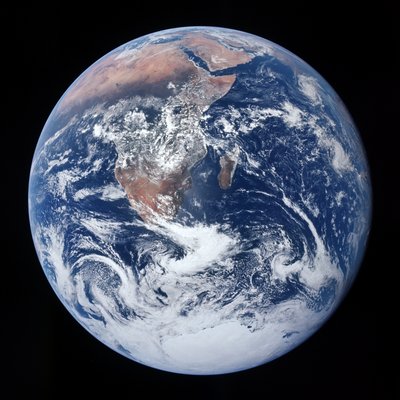
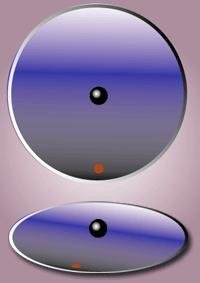
Earth radius (denoted as R 🜨 or R E) is the distance from the center of Earth to a point on or near its surface. Approximating the figure of Earth by an Earth spheroid (an oblate ellipsoid), the radius ranges from a maximum (equatorial radius , denoted a) of about 6,378 km (3,963 mi) to a minimum (polar radius , denoted b) of nearly 6,357 km (3,950 mi).
A globally-average value is usually considered to be 6,371 kilometres (3,959 mi) with a 0.3% variability (±10 km) for the following reasons. The International Union of Geodesy and Geophysics (IUGG) provides three reference values: the mean radius (R 1) of three radii measured at two equator points and a pole; the authalic radius , which is the radius of a sphere with the same surface area (R 2); and the volumetric radius , which is the radius of a sphere having the same volume as the ellipsoid (R 3). All three values are about 6,371 kilometres (3,959 mi).
Other ways to define and measure the Earth's radius involve either the spheroid's radius of curvature or the actual topography. A few definitions yield values outside the range between the polar radius and equatorial radius because they account for localized effects.
A nominal Earth radius (denoted R E N {\displaystyle {\mathcal {R}}_{\mathrm {E} }^{\mathrm {N} }} ) is sometimes used as a unit of measurement in astronomy and geophysics, a conversion factor used when expressing planetary properties as multiples or fractions of a constant terrestrial radius; if the choice between equatorial or polar radii is not explicit, the equatorial radius is to be assumed, as recommended by the International Astronomical Union (IAU).
Earth Radius News
Tags
No tags available for this topic.