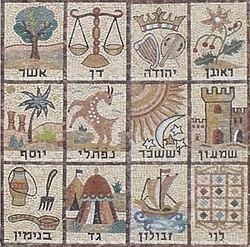


Description
The Hebrews (Hebrew: עִבְרִיִּים / עִבְרִים, Modern: ʿĪvrīm / ʿĪvrīyyīm, Tiberian: ʿĪḇrīm / ʿĪḇrīyyīm; ISO 259-3: ʕibrim / ʕibriyim ) were an ancient Semitic-speaking people who are mostly considered to be synonymous with the Israelites, with the term "Hebrew" denoting an Israelite from the nomadic era that preceded the establishment of the Kingdom of Israel. However, in some instances, it may also be used in a wider sense, referring to the Phoenicians or other ancient civilizations, such as the Shasu on the eve of the Late Bronze Age collapse, appearing 34 times within 32 verses of the Hebrew Bible. It is sometimes regarded as an ethnonym and sometimes not.
By the time of the Roman Empire, the term Hebraios (Greek: Ἑβραῖος) was used to refer to the Jews in general (as Strong's Hebrew Dictionary puts it, "any of the Jewish Nation") or, at other times, specifically those Jews who lived in Judaea. However, at the time of early Christianity, the term instead referred to Jewish Christians, as opposed to the Judaizers and the gentile Christians (Acts 6:1, among others). Judaea was, from 6 CE until 135 CE, a Roman province in which the Jews' sacred Temple in Jerusalem stood until 70 CE, when it was destroyed by the Roman army.
In Armenian, Georgian, Italian, Greek, the Kurdish languages, Old French, Serbian, Russian, Romanian, and a few other languages, the transfer of the name from "Hebrew" to "Jew" never took place, and "Hebrew" is still the primary word used to refer to an ethnic Jew.
With the revival of the Hebrew language and the emergence of the Yishuv, the term has been applied to the Jewish people of this re-emerging society in Israel or the Jewish people in general.
Hebrews News
Tags ≈ Hebrews
Collections
No collections available for this topic.