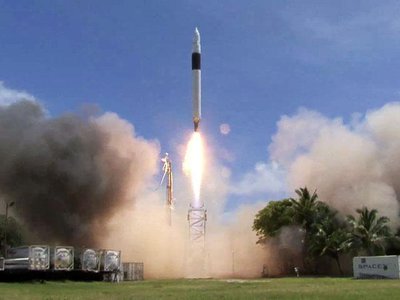


Description
Long March 5 ( LM-5 ; Chinese: 长征五号; pinyin: Chángzhēng wǔ hào ), or Changzheng 5 ( CZ-5 ), and also by its nickname " _ Pang-Wu " (胖五, " _Fat-Five "), is a Chinese heavy-lift launch vehicle developed by the China Academy of Launch Vehicle Technology (CALT). It is the first Chinese launch vehicle designed to use exclusively non-hypergolic liquid propellants. It is the fifth iteration of the Long March rocket family.
There are currently two CZ-5 variants: CZ-5 and CZ-5B. The maximum payload capacities are approximately 25,000 kg (55,000 lb) to low Earth orbit (for CZ-5B) and approximately 14,000 kg (31,000 lb) to geostationary transfer orbit (for CZ-5).
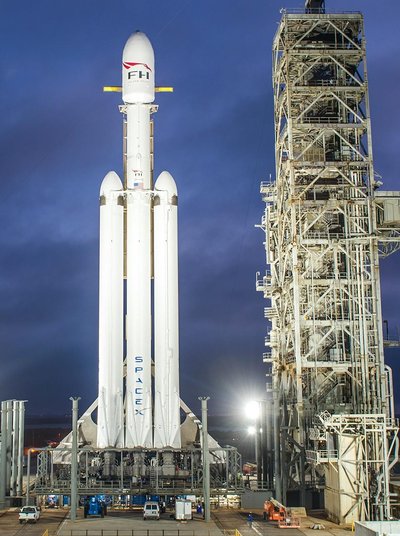
The Long March 5 roughly matches the capabilities of American NSSL heavy-lift launch vehicles such as the Delta IV Heavy. It is currently the most powerful member of the Long March rocket family and the world's fourth most powerful orbital launch vehicle currently in operation, trailing the Delta IV Heavy, Falcon Heavy, and the Space Launch System.
The first CZ-5 launched from Wenchang Space Launch Site on 3 November 2016 and placed its payload in a suboptimal but workable initial orbit. The second CZ-5 rocket, launched on 2 July 2017, failed due to an engine problem in the first stage.
After an interval of almost two and a half years, the Long March 5 vehicle's return to flight mission (third launch) successfully occurred on 27 December 2019 with the launch and placement of the experimental Shijian-20 communications satellite into geostationary transfer orbit, thereby paving the way for the successful launch of Tianwen 1 Mars mission, lunar Chang'e 5 sample-return mission, and the modular space station, all of which require the lifting capabilities of a heavy lift launch vehicle.
Long March 5 News
Collections
No collections available for this topic.