

Description
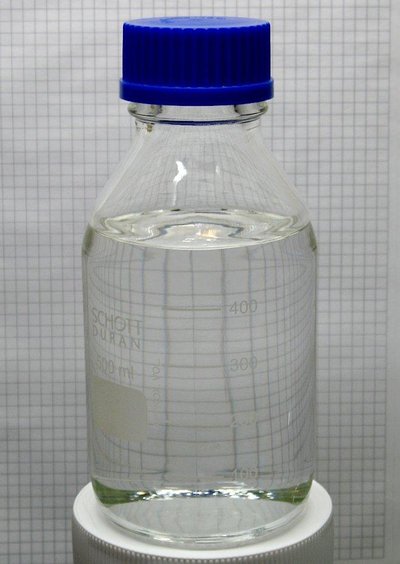
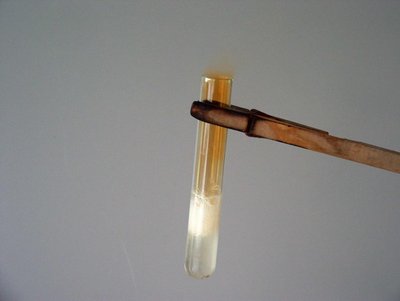
Oleum (Latin oleum , meaning oil), or fuming sulfuric acid , is a term referring to solutions of various compositions of sulfur trioxide in sulfuric acid, or sometimes more specifically to disulfuric acid (also known as pyrosulfuric acid).
Oleums can be described by the formula y SO3·H2O where y is the total molar mass of sulfur trioxide content. The value of y can be varied, to include different oleums. They can also be described by the formula H2SO4· x SO3 where x is now defined as the molar free sulfur trioxide content. Oleum is generally assessed according to the free SO3 content by mass. It can also be expressed as a percentage of sulfuric acid strength; for oleum concentrations, that would be over 100%. For example, 10% oleum can also be expressed as H2SO4· 0.13611 SO3, 1.13611 SO3·H2O or 102.25% sulfuric acid. The conversion between % acid and % oleum is:
% acid = 100 + 18 80 × % oleum {\displaystyle \%\,{\text{acid}}=100+{\frac {18}{80}}\times \%\,{\text{oleum}}}
For x = 1 and y = 2 the empirical formula H2S2O7 for disulfuric (pyrosulfuric) acid is obtained. Pure disulfuric acid is a solid at room temperature, melting at 36 °C and rarely used either in the laboratory or industrial processes — although recent research indicates that pure disulfuric acid has never been isolated yet.