
Description
Phobos (; systematic designation: Mars I ) is the innermost and larger of the two natural satellites of Mars, the other being Deimos. The two moons were discovered in 1877 by American astronomer Asaph Hall. It is named after Phobos, the Greek god of fear and panic, who is the son of Ares (Mars) and twin brother of Deimos.
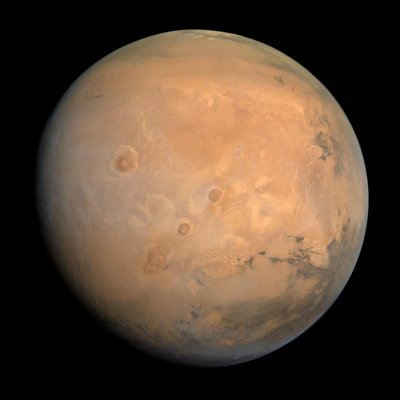
Phobos is a small, irregularly shaped object with a mean radius of 11 km (7 mi). Phobos orbits 6,000 km (3,700 mi) from the Martian surface, closer to its primary body than any other known planetary moon. It orbits Mars much faster than Mars rotates and completes an orbit in just 7 hours and 39 minutes. As a result, from the surface of Mars it appears to rise in the west, move across the sky in 4 hours and 15 minutes or less, and set in the east, twice each Martian day.
Phobos is one of the least reflective bodies in the Solar System, with an albedo of 0.071. Surface temperatures range from about −4 °C (25 °F) on the sunlit side to −112 °C (−170 °F) on the shadowed side. The notable surface feature is the large impact crater, Stickney, which takes up a substantial proportion of the moon's surface. The surface is also home to many grooves, with there being numerous theories as to how these grooves were formed.
Images and models indicate that Phobos may be a rubble pile held together by a thin crust that is being torn apart by tidal interactions. Phobos gets closer to Mars by about 2 cm per year, and it is predicted that within 30 to 50 million years it will either collide with the planet or break up into a planetary ring.