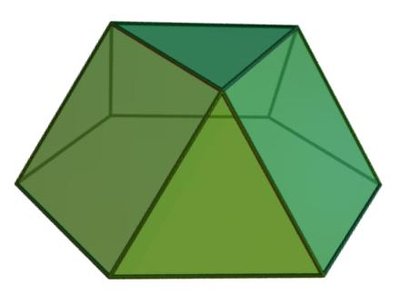


Description
In geometry, a regular icosahedron ( or ) is a convex polyhedron with 20 faces, 30 edges and 12 vertices. It is one of the five Platonic solids, and the one with the most faces.
It has five equilateral triangular faces meeting at each vertex. It is represented by its Schläfli symbol {3,5}, or sometimes by its vertex figure as 3.3.3.3.3 or 35. It is the dual of the regular dodecahedron, which is represented by {5,3}, having three pentagonal faces around each vertex. In most contexts, the unqualified use of the word "icosahedron" refers specifically to this figure.
A regular icosahedron is a strictly convex deltahedron and a gyroelongated pentagonal bipyramid and a biaugmented pentagonal antiprism in any of six orientations.
The name comes from Greek __ εἴκοσι (eíkosi) 'twenty', and __ ἕδρα (hédra) 'seat'. The plural can be either "icosahedrons" or "icosahedra" ().
Regular Icosahedron News
Collections
No collections available for this topic.