
Description
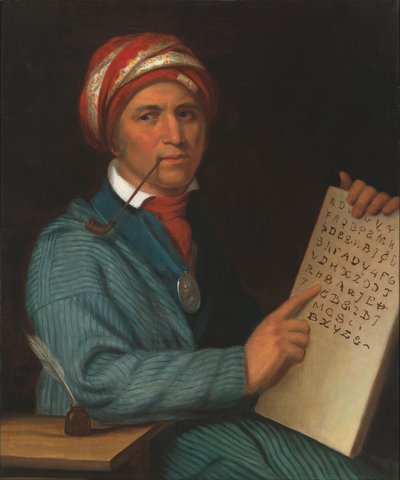
Sequoyah (Cherokee: ᏍᏏᏉᏯ, Ssiquoya , or ᏎᏉᏯ, Se-quo-ya ; IPA: [seɡʷoja], c. 1770 – August 1843), also known as George Gist or George Guess , was a Native American polymath and neographer of the Cherokee Nation. In 1821, he completed his independent creation of the Cherokee syllabary, making reading and writing in Cherokee possible. His achievement was one of the few times in recorded history that an individual who was a member of a pre-literate group created an original, effective writing system. His creation of the syllabary allowed the Cherokee nation to be one of the first North American Indigenous groups to have a written language. Sequoyah was also an important representative for the Cherokee nation, by going to Washington, D.C. to sign two relocations and trading of land treaties.
After seeing its worth, the people of the Cherokee Nation rapidly began to use his syllabary and officially adopted it in 1825. It unified a forcibly divided nation with new ways of communication and a sense of independence. By the 1850s, their literacy rate reached almost 100%, surpassing that of surrounding European-American settlers.
The Cherokee syllabary has had international influence. As diffusion spread, it is believed to have inspired the development of 21 known scripts or writing systems, used in a total of 65 languages in North America, Africa, and Asia.
*[c.]: circa