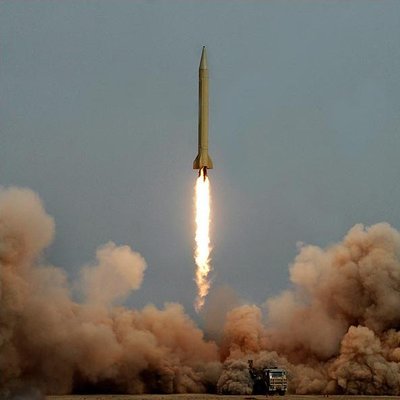
 Shahab-3
Swipe Shahab-3 Vs...
Shahab-3
Swipe Shahab-3 Vs...


Shahab-3 News
Description
The Shahab-3 (Persian: شهاب ۳, romanized: Šahâb 3 ; meaning "Meteor-3") is a family of liquid-fueled ballistic missiles developed by Iran, under the IRGC, and based upon the North Korean Nodong-1/A and Nodong-B missiles. The Shahab-3 family has a range of 1,000-2,000 kilometres (1,200 mi). It was tested from 1998 to 2003 and added to the military arsenal on 7 July 2003, with an official unveiling by Ayatollah Khamenei on July 20. It has an estimated accuracy of about 2,500m CEP. According to the IAEA, Iran in the early 2000s may have explored various fuzing, arming and firing systems to make the Shahab-3 more capable of reliably delivering a nuclear warhead.
The forerunners to this missile include the Shahab-1 and Shahab-2. Iran's Defense Ministry has alternately denied plans to develop a Shahab-4 and admitted that a Shahab-4 program is in development, having claimed it both to be a MRBM and an SLV. Some successors to the Shahab have longer range and are more maneuverable.
Operating under the Sanam Industrial Group (Department 140), which is part of the Defense Industries Organization of Iran, the Shahid Hemmat Industrial Group (SHIG), led the development of the Shahab missile.
In 2019, the US Defense Intelligence Agency described the Shahab 3 as "the mainstay of Iran’s MRBM force". In June 2017, the US Air Force National Air and Space Intelligence Center estimated that fewer than 50 launchers were operationally deployed.
Shahab-3 missiles are considered obsolete and are being progressively changed for their more recent upgrades of Shahab family missiles, such as the Ghadr-110H and Emad missile. The US government says that the Shahab-3 is "generally" less accurate than the Fateh-110.
Related
More











Tags
No tags available for this topic.
Collections
Details
- Slug: shahab-3
- Total Views: 359
- Added: Jul 02, 2025