

Description
The core of the Sun is considered to extend from the center to about 0.2 to 0.25 of solar radius (140,000–170,000 kilometres (87,000–106,000 mi)). It is the hottest part of the Sun and of the Solar System. It has a density of 150000 kg/m3 (150 g/cm3) at the center, and a temperature of 15 million kelvins (15 million degrees Celsius, 27 million degrees Fahrenheit).
The core is made of hot, dense plasma (ions and electrons), at a pressure estimated at 2.65×10¹⁶ Pa (or 265 billion bar or 3.84 trillion psi at the center. Due to fusion, the composition of the solar plasma drops from 68 to 70% hydrogen by mass at the outer core, to 34% hydrogen at the core/Sun center.
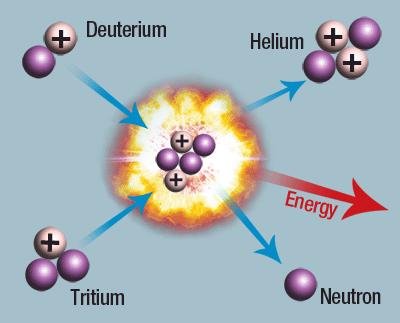
The core inside 20% of the solar radius contains 34% of the Sun's mass, but only 0.8% of the Sun's volume. Inside 24% of the solar radius is the core which generates 99% of the fusion power of the Sun. There are two distinct reactions in which four hydrogen nuclei may eventually result in one helium nucleus: the proton–proton chain reaction – which is responsible for most of the Sun's released energy – and the CNO cycle.