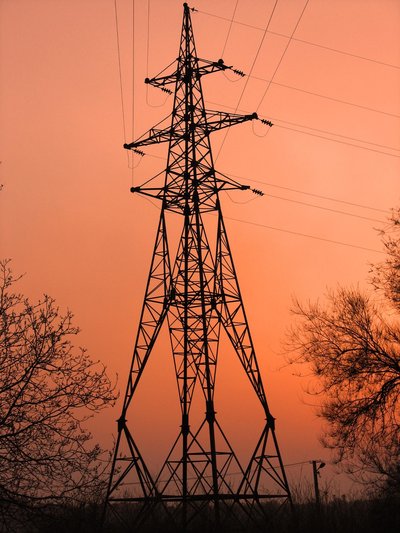




Description
A transmission tower (also electricity pylon , hydro tower in Canada, and pylon in Britain) is a tall structure, usually a lattice tower made of steel that is used to support an overhead power line. In electrical grids, transmission towers carry high-voltage transmission lines that transport bulk electric power from generating stations to electrical substations, from which electricity is delivered to end consumers; moreover, utility poles are used to support lower-voltage sub-transmission and distribution lines that transport electricity from substations to electricity customers.
There are four categories of transmission towers: (i) the suspension tower, (ii) the dead-end terminal tower, (iii) the tension tower, and (iv) the transposition tower. The heights of transmission towers range from 15 to 55 m (49 to 180 ft); the tallest are the 380 m (1,247 ft) transmission towers of a 2,656 m (8,714 ft) span of the Jintang-Cezi Overhead Powerline Link, between the islands Jintang and Cezi in Zhejiang province, China. The longest span of a hydroelectric crossing is the Ameralik Span of the powerline crossing of Ameralik fjord, with a length of 5,376 m (17,638 ft). More transmission towers are needed to mitigate climate change, so in the 2020s transmission towers became politically important.